The watch that found the sea: Harrison's H4 and the longitude prize
In 1714 Parliament offered a fortune to anyone who could fix a ship's position east to west. Astronomers expected to win it. A self-taught Yorkshire carpenter won with a big silver watch.
Latitude was never the hard part. A navigator could measure the height of the sun at noon, check a table, and know roughly how far north or south he was. East and west was another matter. Out of sight of land, ships ran on dead reckoning: speed, heading and hope. On long voyages the errors piled up, and ships ran onto rocks their officers thought were miles away.
The answer, in principle, was simple. The Earth turns 15 degrees every hour. If you know the local time on board (from the sun) and the time at your home port at that same moment, the difference gives you your longitude. The problem was keeping home-port time for weeks on a pitching, damp ship whose temperature swung from the Channel to the tropics. No clock of the early 1700s came close.
A prize worth a fortune
In 1714 Parliament passed the Longitude Act. It offered rewards of up to £20,000, a huge sum then, for a practical method of finding longitude at sea, with the top prize reserved for a method good to within half a degree. A Board of Longitude was set up to judge the claims. Most of its members were astronomers, and most of them expected the winner to come from the sky: tables of the moon's motion against the stars, or the eclipses of Jupiter's moons.
John Harrison was not an astronomer. He was a carpenter from Lincolnshire who had taught himself clockmaking. By the mid-1720s he had built wooden longcase clocks that, according to Royal Museums Greenwich, kept time to about a second a month, far better than anything else of the period. He reasoned that a clock good enough could carry home-port time to sea.
Three clocks, one dead end
Harrison came to London and found support from Edmond Halley, the Astronomer Royal, and from the leading clockmaker George Graham. Back home in Barrow upon Humber, probably with help from his brother James, he built his first sea clock, now called H1. It used two large balances linked so that a ship's rolling could not upset them both at once.
In 1736 H1 went to Lisbon aboard HMS Centurion and came back on the Orford. On the return leg Harrison told the officers that the headland ahead was the Lizard, not Start Point as they believed. He was right; the ship was well off its reckoned course. In 1737 the Board met to consider the clock and agreed to pay Harrison £500, half in advance, so he could build an improved version.
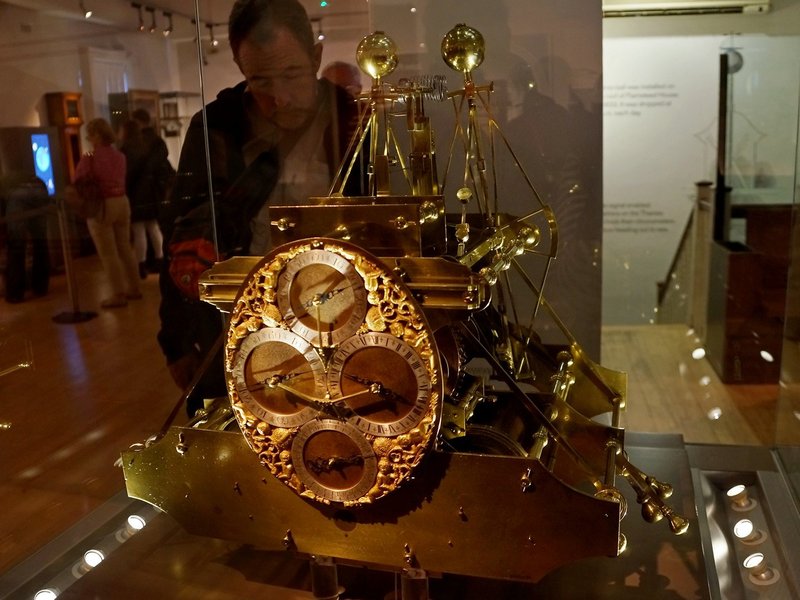
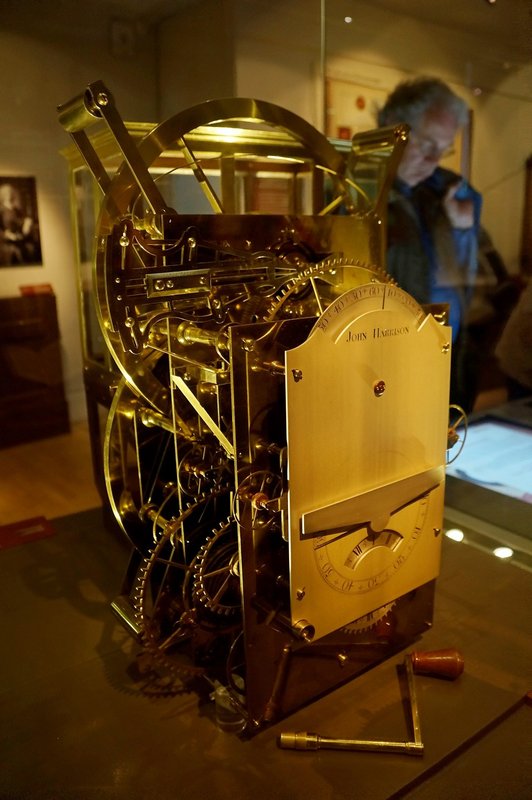
That second clock, H2, never went to sea, because Harrison found a basic flaw in it. He began H3 in 1740 and kept working on it for 19 years. It brought real inventions, including a bimetallic strip to correct for temperature and caged roller bearings, but it never kept time well enough.
The watch nobody expected
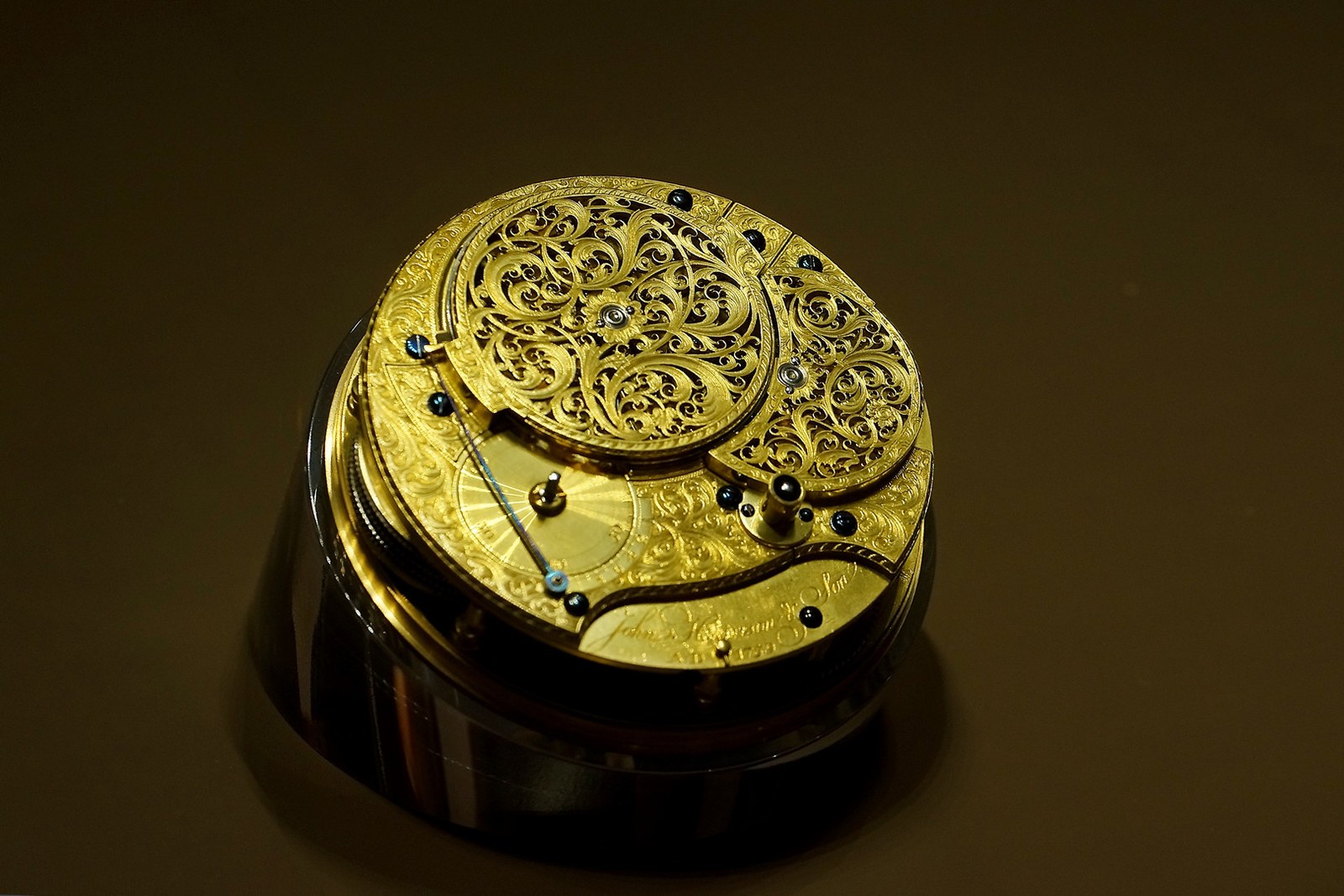
The turn came from a much smaller object. In 1753 the watchmaker John Jefferys made a pocket watch to Harrison's design, and it performed so well that Harrison changed direction. At the time nobody considered a watch a serious precision instrument. Harrison started H4 in 1755 and finished it in 1759.
H4 looks like an oversized pocket watch in a silver pair case. The museum lists the dial at 102 mm and the whole watch at about 1.45 kg. What makes it different is inside. Its balance is large and fast: H4 ticks five times a second and swings through a wide arc, which makes it far less easily disturbed by the ship's motion than a normal watch of the day. Jewelled pallets, a remontoire that rewinds a small spring every few seconds to keep the drive force even, and temperature compensation all helped.
Jamaica, then Barbados
In November 1761 Harrison's son William sailed with H4 aboard HMS Deptford, bound for Jamaica. On the way out, William used the watch to predict landfall at Madeira earlier than the crew expected, and it duly appeared. The result at Jamaica was well within the Act's limits.
The Board was not satisfied. Its members said the trial had not been rigorous enough, and relations between the Harrisons and the commissioners soured. A second trial was set, this time to Barbados in 1764, with the astronomer Nevil Maskelyne sent ahead to fix the island's longitude by observing Jupiter's moons, so the watch and the astronomical methods could be compared.
In February 1765 the Board confirmed that H4 had kept time within the strictest limits of the 1714 Act. Then it moved the goalposts. Harrison would get £10,000 once he explained how H4 worked, and the rest only when other makers had shown that such watches could be built again. A new Longitude Act made those conditions law in May 1765. The Harrisons felt, with some reason, that the rules had been changed after the game was won.
Proof by copying
Harrison handed over the secrets. In 1766 H4 went to Maskelyne at the Royal Observatory for ten months of testing in which it did badly, which reopened the quarrel. Meanwhile the watchmaker Larcum Kendall, who had trained under John Jefferys, made a copy, now known as K1. Captain James Cook took K1 on his second and third voyages to the Pacific, and his logs praise it. His charts of the southern Pacific proved remarkably accurate. That was the proof the Board had asked for, even if it never paid out the rest of the prize.
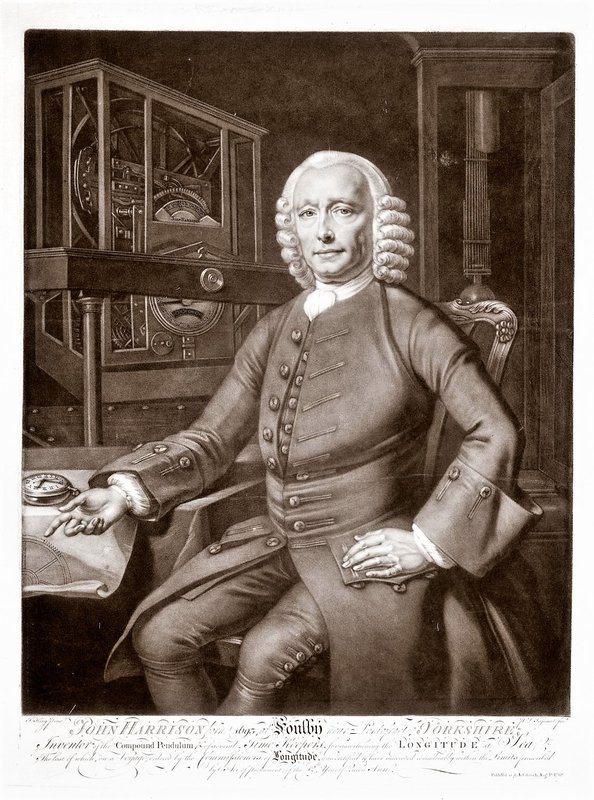
Harrison went over the Board's head. With the King's support he petitioned Parliament, and in 1773, at 80, he received £8,750 for his services. Counting the Board's earlier payments and the £10,000 for H4, he had received about £23,000 in all. He died in London on 24 March 1776.
What changed
H4 did not put a chronometer on every ship. It was a masterpiece, far too costly to build in numbers. Makers such as John Arnold and Thomas Earnshaw spent the next decades simplifying the marine chronometer until, early in the 1800s, it became an ordinary piece of ship's equipment. But Harrison had shown that the answer to the longitude problem could be mechanical. A machine could carry time across an ocean.
You can still see the original H2, H3 and H4, and a replica of H1, at the Royal Observatory Greenwich. The original H1 is in conservation at the museum's collections centre.
From the bench
What strikes a watchmaker about H4 is how much of it points forward. The fast, wide-swinging balance is the core idea behind modern precision watches, which still look for a strong amplitude and a high, steady beat. Harrison also understood that the drive force has to be kept even, hence the remontoire. Two and a half centuries later, constant-force mechanisms are still a mark of serious watchmaking.
Gallery
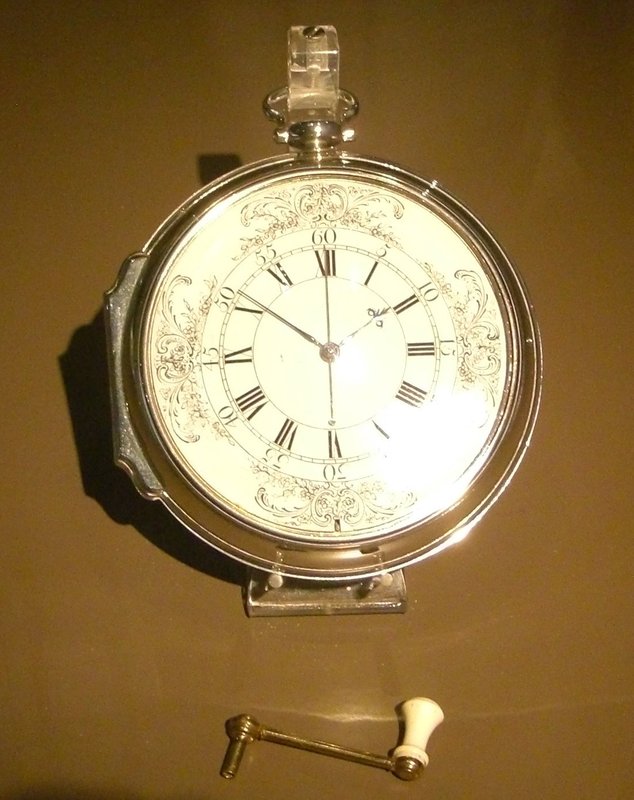
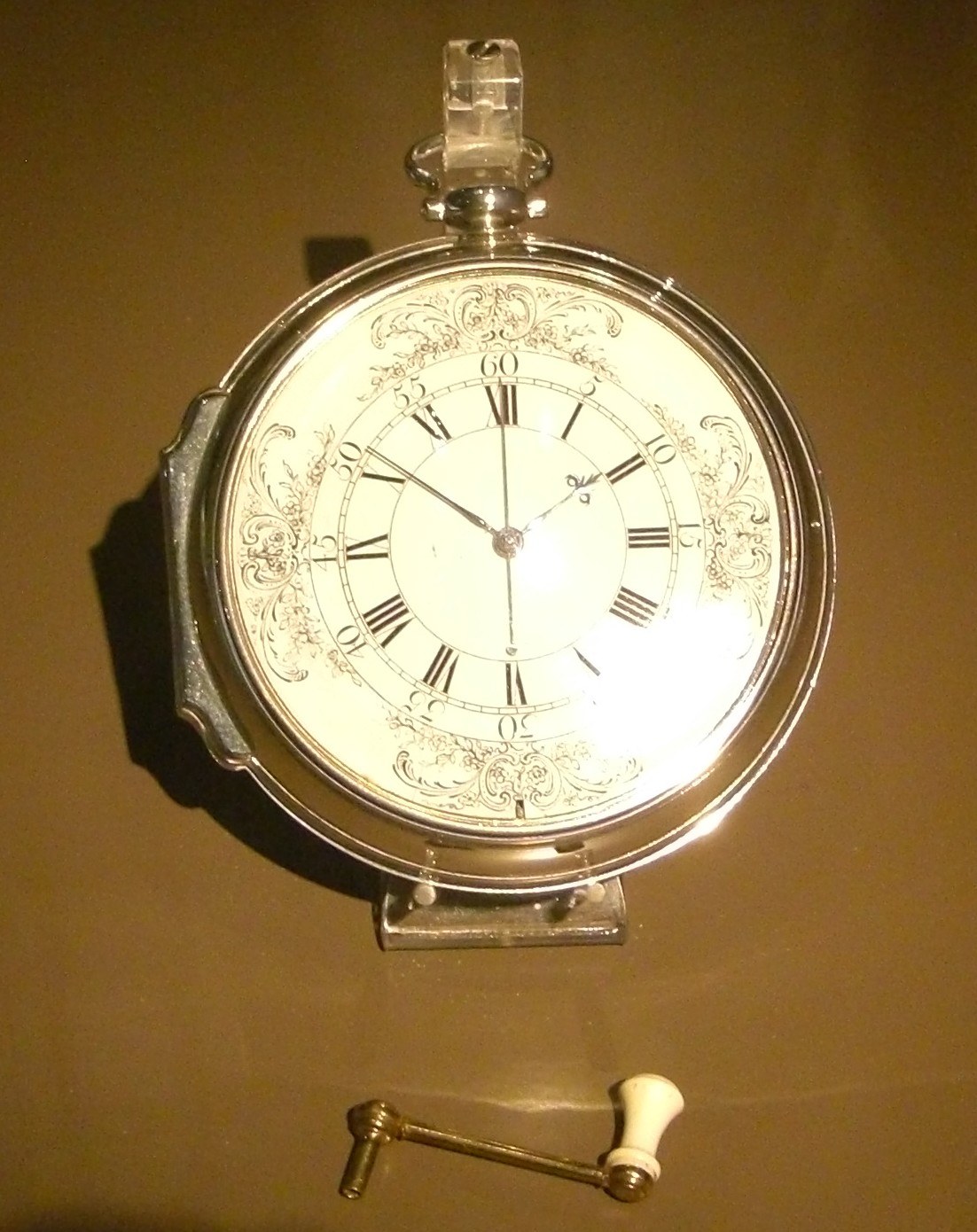
H4 from the front. The dial is 102 mm across and the whole watch weighs about 1.45 kg. Photo: Colonel Warden · CC BY-SA 3.0 · Wikimedia Commons

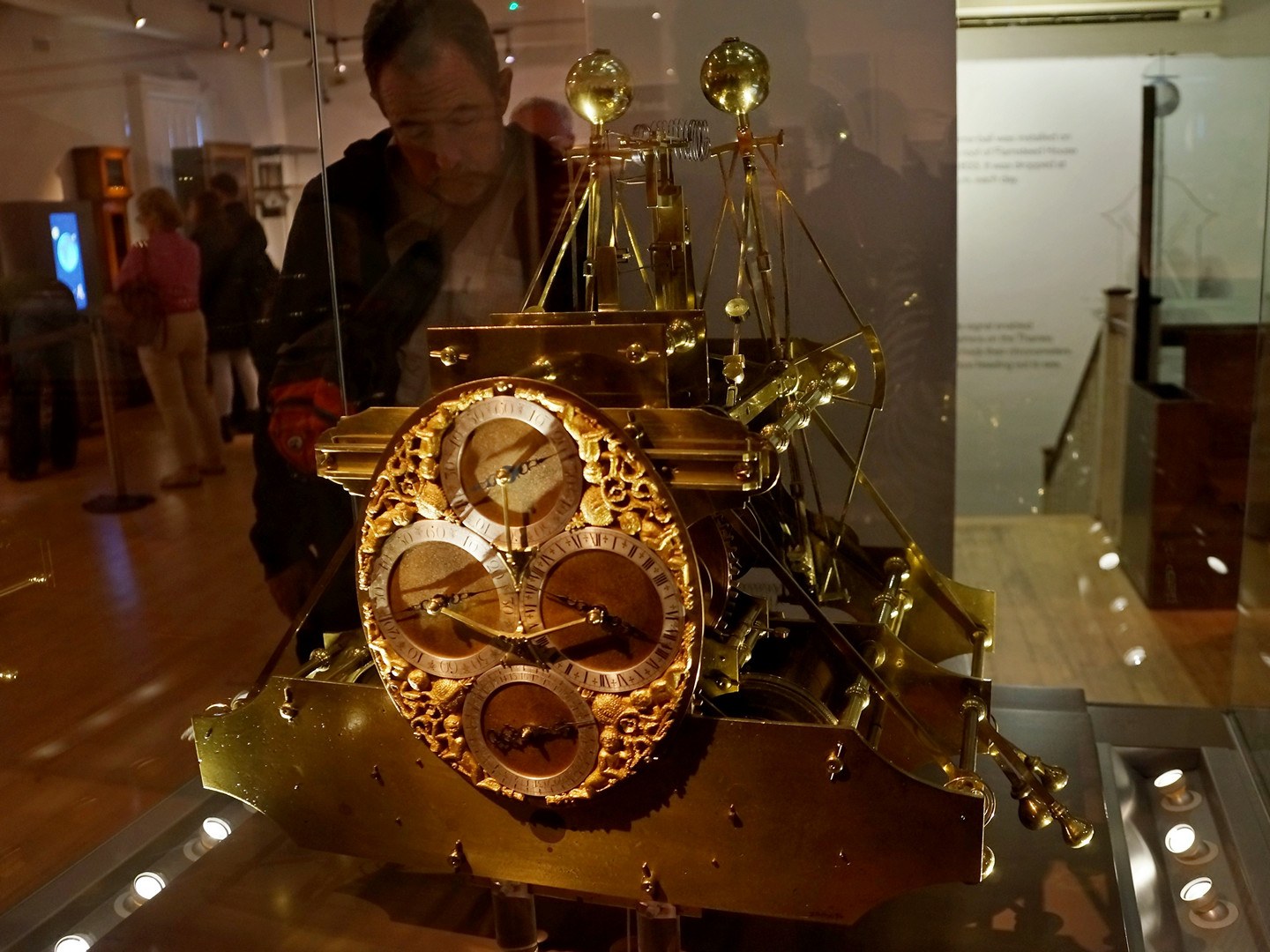
H1 (1730–35), the first of the sea clocks, with its two linked swinging balances. Photo: Tatters (Flickr) · CC BY-SA 2.0 · Wikimedia Commons
_-_Flickr_-_Tatters_%E2%9D%80.jpg)
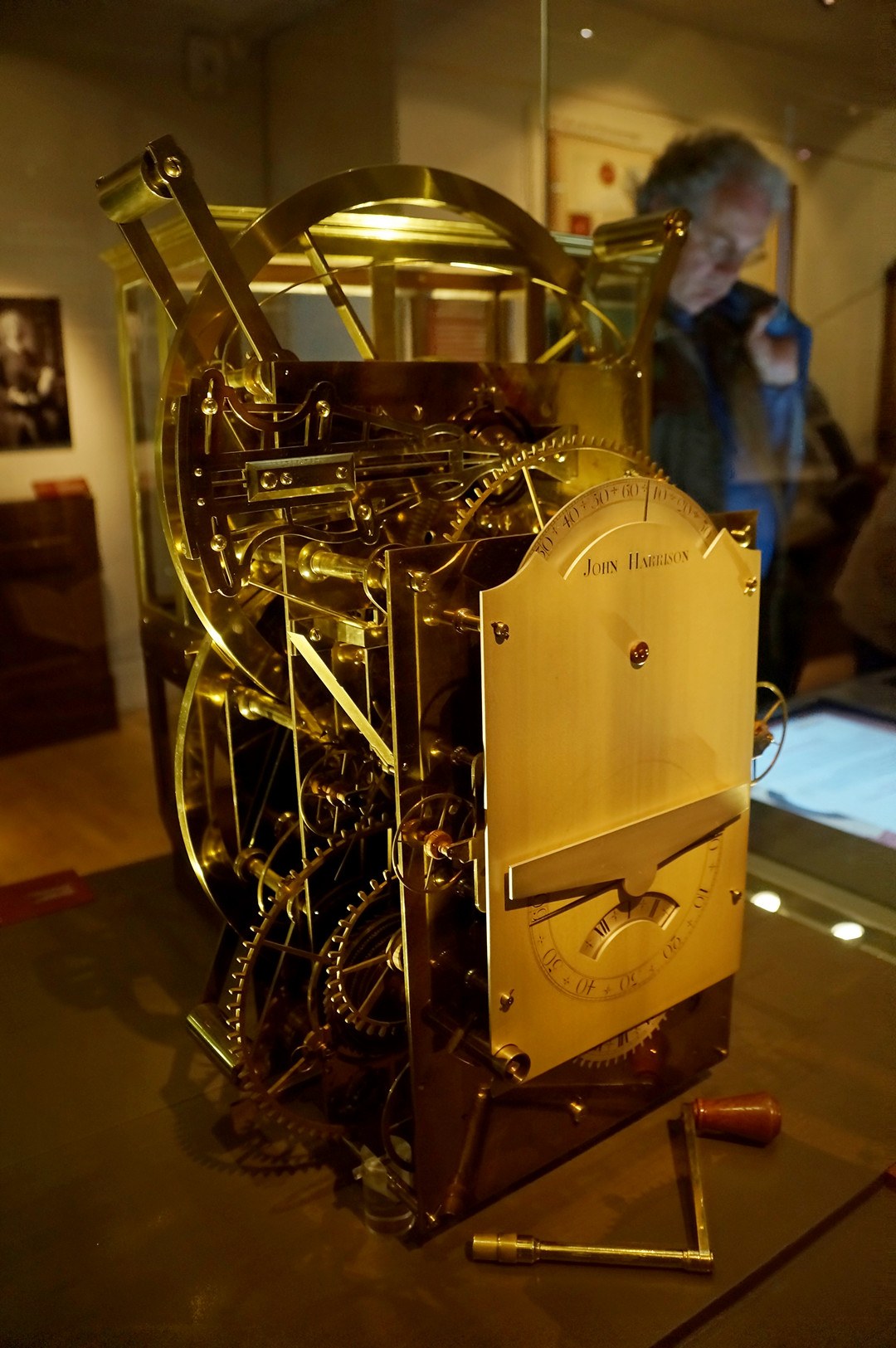
H3, the clock Harrison worked on for 19 years before deciding the answer was a watch. Photo: Tatters (Flickr) · CC BY-SA 2.0 · Wikimedia Commons
_-_Flickr_-_Tatters_%E2%9D%80.jpg)
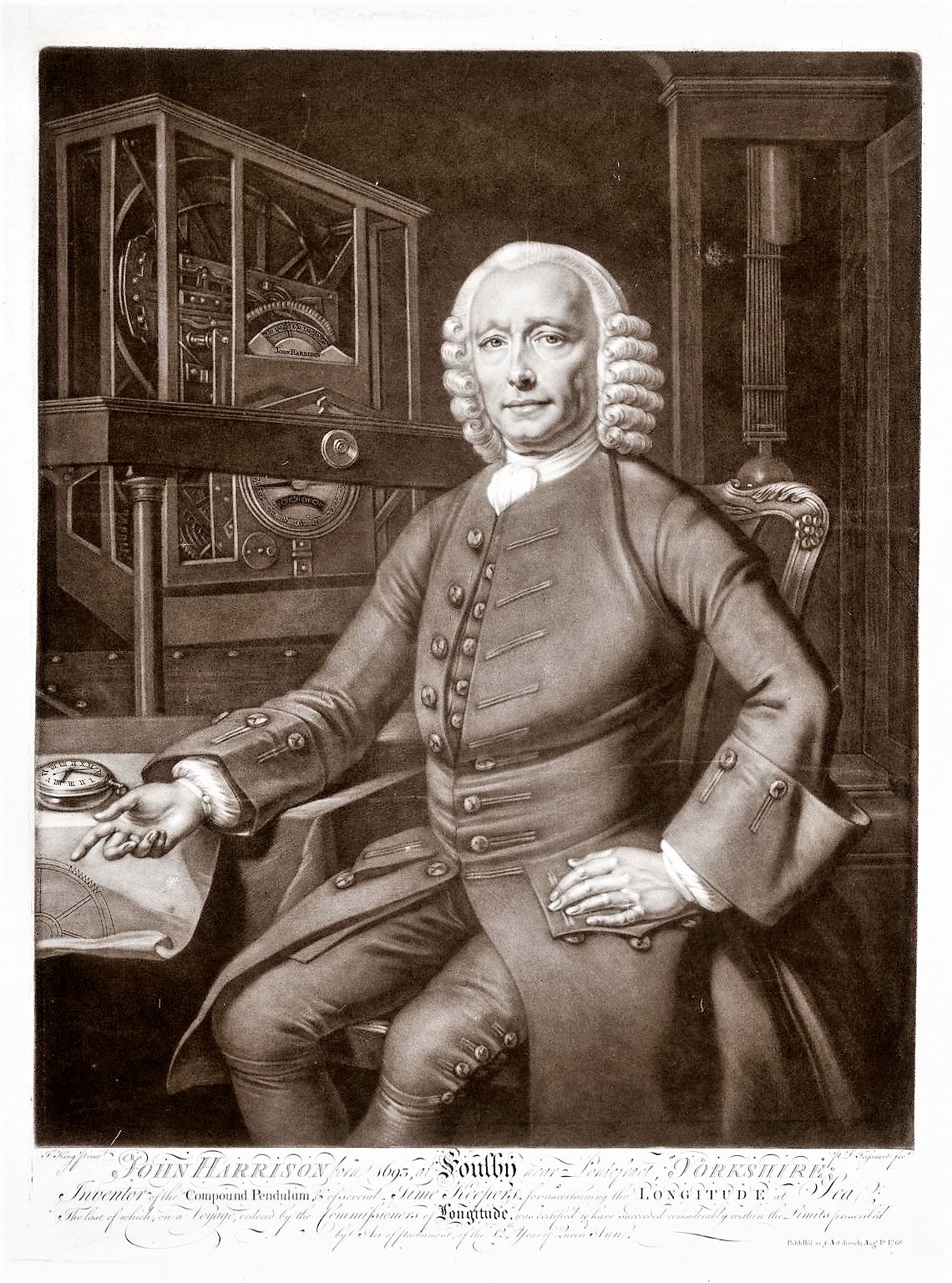
John Harrison, engraved after the oil portrait by Thomas King. Engraving after Thomas King · CC BY-SA 4.0 (Commons scan) · Wikimedia Commons

Sources
- Royal Museums Greenwich: Longitude found: the story of Harrison's timekeepers
- Royal Museums Greenwich, collections: H4, marine timekeeper (ZAA0037)
- Wikipedia: John Harrison and Longitude rewards
- Cambridge Digital Library: Papers of the Board of Longitude
- F. J. Britten, The Watch & Clockmakers' Handbook (1881), archive.org